
OK, it is the middle of June and about 2&1/2 months since the last application of herbicides at Lake Martin and so far I have yet to witness another visit of the plant control boat to the lake. So.. maybe this blog is helping to curb and address the issue of plant contol as being out of control.
When I first began doing tours at Lake Martin full-time in 1996, I was in awe of the abundance of plants and wildlife and the diversity of species. I wondered why was this place so different from every other swamp I had known before. Well, when plant control arrived in 1997, I soon began to learn why.
The first thing they did in the name of plant control, was to apply a granular herbicide with a crop duster type airplane and killed all the hydrilla in the lake and ALL the fish with it. The minor fish killed that was the result of the drought the year before was nothing compared to the fish kill that followed the plant control in May of 1997.
The next thing they did was to introduce grass eating carp to "mow down" aquatic plants. The only fish in the lake for about 4 years after plant contol came was the grass eating Chinese carp put in there to help "control" the plants.
Initially I noticed that the fingerling carp were growing and having a positive effect in gradually reducing the hydrilla that rapidly returned after the crop dusting. But apparently the Wildlife and Fisheries biologists wanted to see quicker results. So they but more of the fingerlings that ultimately grow to over 40 lbs.
The result was, after the fingerlings all mutured there were too many and the plants that were once the cover and first link in the food chain were completely gone.
Below is a photo of a mature carp caught in Lake Martin by a very proud fisherman.

Below is a picture of the "barrier" which was installed to prevent the non-indigenous carp from escaping Lake Martin and wreaking havoc in the wetlands of Louisiana. The carp are "guaranteed" by the company who sells them to be 99% sterile and thus prevent reproduction and over-population. But if only one is fertile and reproduction is possible and should they escape Lake Martin, then we will have an ecological disaster in the making in the plant kingdom of Louisiana.
Notice in the photo below that someone has removed or maybe something has damaged the barrier and it is now ineffective in trapping the carp.
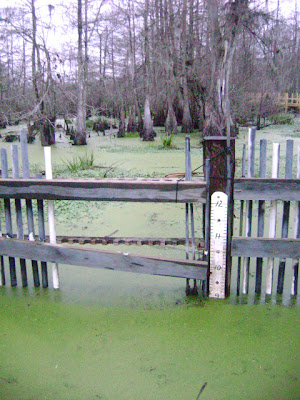
But never mind that, we already know that another barrier of chain link fence installed along Rookery Road in 1998 was insufficent to contain the carp in the flood of June 2001 when Tropical Strom Allison dumped 40" of rain in 5 days and raised water levels enough to allow the carp to swim over the fence, leave the lake and work their way to Bayou Tortue. I have eye-witnesses who lived on Bayou Tortue who contacted me with sightings of the carp miles from the lake shortly after the flood. Based upon unconfirmed reports thousands of these carp have been released into Lake Martin. We know the carp can escape, what we don't know is if there are fertile carp in there poseing a threat to Louisiana's indigenous plants and thus the entire ecosystem. Remember, plants are the first link in the food chain and any absence or decrease in diversity creates an imbalance or shortage of relationships between species and that leads to an ecological collapse.
Not only have the submerged species such as aquatic bladderwort, coontail and hydrilla been nearly completely exterminated also the floating mats of pennywort, frog bit, dollar bonnet, and duckweed.
It is a swamp! It is supposed to be filled with plants. Not only an abundance but, also a diversity of plants is important. Honestly, my greatest arguement is not about plant control per se, grass eating carp, or Agent Orange. My complaint is about the management of the barrier, the annual drainage of water, and the over-kill of the herbicide being used. The Wildlife and Fisheries plant control personel go into the lake with a boat rigged with a spay unit throwing a stream of chemical about 50ft and spray everything. Trees, button bush, aquatic plants, alligators, frogs, birds, fish and people.
I have testimonials of fisherman who went to the lake for recreational fishing but had to go home early because they were overcome by the fumes after fishing in an area where plant control had applied this dangerous herbicide. I too, have had terrible head aches for days after being exposed to
Agent Orange while doing tours at Laker Martin.
Truth is stranger than fiction. Is it any wonder most people think I am crazy to propose that
Agent Orange is the herbicide being applied to Lake Martin to control plants? If the purpose of applying this dangerous chemical is to control plants "in" the lake, why is the Louisiana Deptment of Wildlife and Fisheries also spraying the levees and the roadside along Rookery Road? The wild iris transplanted by the Boy Scouts about 20 years ago, and about 10 years ago the Girl Scouts planted bald cypress saplings along Rookery Road, all are being sprayed. The indigenous American Lotus I transplanted about 8 years ago into the lake, has been repeatedly knocked down in the plant control operations. Maybe plant control is out of control.
Last month I came upon a young couple picking dewberries along the walking trail. I drove my boat over to where they were sqatted in the weeds and asked them if they were aware that those berries and all the dying plants around them had been sprayed with a herbicide. They seemed amused by my proposal. I further advided them that the herbicide was agent orange. They didn't seem to care, and kept on picking berries. This breaks my heart.
Not only have I witnessed an unbelieveable decline in the population of fish, frogs, turtles, alligators and birds since the plant control arrived, I have considered leaving Lake Martin too.
But... the Creator gave us a garden, He told us to guard, tend, keep and utilize all the resources therein in service to Him and man. I also believe that the stronger members of the tribe should protect and provide for the weaker members. My strength is in logical comprehension, communication, and education. I am a teacher and I have a responsibility to educate the public at large regarding the dangers that are associated with visiting Lake Martin due to the application of this dangerous chemical. I have been advised that I shouldn't tell my swamp tour guests about the truth regarding Agent Orange because it might be "bad" for business. Well folks, I am in the people business! Therefore, if my guests are exposed to danger as a result of my governments activities I will warn them and hope that I can build support for this cause to protect the wildlife and tourists who come to Lake Martin.
Presently, I am working on a documentary film and interviewing fisherman who have been fishing Lake Martin before and after the plant control. They agree with me that compared to what it once was, Lake Martin is now an aquatic desert.
One of the plants being destoyed is
duckweed which is a member of the genus Lemna.

I first learned of the importance of duckweed in water purification from employees of the
Lemna Corporation who were installing a municipal waste water treatment plant using algae and duckweed to purify waste water sewage in Baldwin, Louisiana.
When I tried to advise a top administrator in the Nature Conservancy regarding the value of the floating mats of plants at Lake Martin, he advised me matter of factly that fish do not live under floating mats of plants and furthermore if they don't control plants there, it(the lake)will fill in with decomposing plants. OK, it has been a lake for 8 or 10 thousand years and you plan to "save it" in your lifetime? In my mind, I began to wonder what planet does he comes from! Every fisherman I talk to admits that the best fishing is almost always under floating mats of plants or in submerged vegetation.
What is the value of duckweed to absorb and purify swamp and lake water?
Perhaps the most important features of these little aquatic plants to freshwater fish is that they are extremely efficient absorbers of ammonia, nitrate, phosphorous, potassium, magnesium, calcium, sodium, chlorine, boron and iron. In a properly managed ecological system, duckweed can remove as much as 99% of the nutrients and dissolved solids in municipal wastewater. Unquestionably, the potential contribution of duckweed to the advancement of sustainable freshwater recreation is enormous, yet surprisingly very little research has been done in this area.
Duckweed is an important food source for waterfowl and are eaten by humans in some parts of Southeast Asia (as khai-nam). Some duckweeds are used in freshwater aquariums and ponds where they may spread rapidly and, in a large pond, may be difficult to eradicate once established. The plants can provide nitrate removal (if cropped) and cover for small fry. The plants are used as shelter by recreational fish and reptile and amphibious species, such as bullfrogs, salamanders, turtles, alligators, sac-a-lait, bass and bluegills. The duckweeds are important in the process of bioremediation because they grow rapidly, absorbing excess mineral nutrients, particularly nitrogen and phosphates. A cover of duckweeds will reduce evaporation of water compared to a clear surface. Duckweed reproduces at a rate of 100% every 24 hours so it has many positive benefits, and here is the problem: Where you have a lot of plants living and dying in the water, there are many plants decomposing in the water. As plants decompose, bactetia metabolizes oxygen and "robs" the water of oxygen.
No problem in Louisiana where we average 60-80" of rain per year. But in 1997 we had a drought and accumulated a mere 20" in one year. Because of a lack of rain to recharge the oxygen supply, a fisk kill resulted. Droughts and fish kills are very much like hurricanes and forest fires, they are a part of natures cycles and we don't like them, but there is not much we can do about them.
Ohh.. sure we can suppress forest fires, with disastrous results. After fighting and suppressing forest fires for decades, the US Forest Service came to the conclusion that fire is an important part of natural or man-made forest management. We realized that a policy of suppressing fire for decades led to an unnatural large accumulation of mulch on the forest floor and this resulted in lightning strikes starting very big fires that were impossible to control and were so hot, they set the canopy of the forest on fire and killed tall, mature tress, due to such intense heat. Soon it was realized that controlled burns were needed to diminish the fuel supply on the forest floor and allow lower story vegetation a chance to sprout and grow after the mulch was burned away. The lower story vegetation would include grass and briars that provided food and cover for mammals and birds often very sensitive to the diversity factor that is crucial to optimum environmental equilibrium. Let's put it another way, anytime species diversity(plant or animal)is diminished, an ecological imbalance results.
So, what does forest fires have to do with plant control at Lake Martin? The importance of aquatic plants is today as much misunderstood and under-valued as was fire in forest management in the 1950's, 60,s and 70's.


